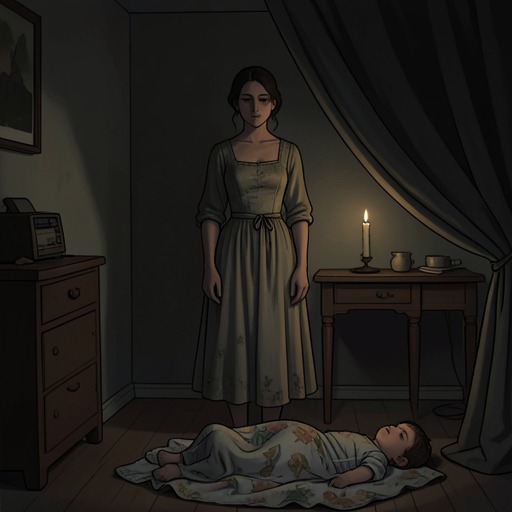
Amparo Priego Martínez
Los pacientes del doctor GarcíaAmparo Priego Martínez is a childhood companion of Guillermo García Medina who becomes his lover during the Spanish Civil War and the mother of their son. Her history is shaped by concealment: she survives in Madrid through a precarious intimacy with Guillermo, then raises their child under a false paternal identity, preserving traces of the family he does not know he belongs to. Decades later, those traces help their son recover a history his parents had kept apart from him.
Identity and Early Life
Amparo grows up with her grandparents, although she is not an orphan. Her father is an engineer employed by a German company exploiting mineral deposits. As a child, she is known to Guillermo as Amparito, the girl whose company makes visits to Don Fermín’s house worthwhile even when the maid, Experta, burns the toast. The children’s friendship develops alongside the Sunday chess games between their grandfathers, a routine of alternating visits that gives their early connection a place within ordinary family life.
When Guillermo sees her again years later, the reunion is set amid the crowd and palms of Palm Sunday. He recognizes her by her striking blond hair, now more golden than he remembers, and by the same beauty he had associated with her as a girl. The adult Amparo dresses to attract attention, in a close-fitting suit and an old black-lace veil. Her dark eyebrows sharply contrast with her dyed-looking yellow hair, a daring appearance that makes her seem out of place among the more restrained women around her. Guillermo registers not only the change in her looks but the persistence of the boldness that had always distinguished her.
Wartime Refuge and Intimacy
During the war, Amparo is left alone in Madrid and has nowhere she feels safe to go. She cannot live at Experta’s home in Vallecas, despite Experta’s kindness, because the neighborhood is identified with the left and its residents know her. Amparo fears that her presence would attract notice and put her in danger. The apartment where she had lived with her grandfather is no refuge either: she remembers being lonely and frightened there, interpreting the sound of the lift as a sign that someone had come to arrest them. Her appeal to Guillermo is therefore not simply a return to an old acquaintance; it is a request for shelter in a city where political identity and neighborhood ties can expose a person.
Their relationship takes shape within the grinding conditions of wartime Madrid. Bombing, ruined buildings, summary executions, fear, and rationing form the surroundings in which their shared life becomes possible. Guillermo describes his existence as caught between two catastrophic spirals, the war and his relationship with Amparo, which twist in opposing directions and come to offset one another. Their domestic arrangement is at once accidental and necessary, emotionally unbalanced and sustaining. Amparo’s dependence on the shelter he offers coexists with an intimacy that binds them more deeply than either can treat as a temporary convenience.
The son born of that relationship becomes the most consequential secret between them. Guillermo’s concealed papers include a family record naming him and Amparo as husband and wife, as well as the birth certificate of their legitimate son, Guillermo. When he later asks Amparo to arrange a meeting with Clarita Stauffer, he uses the surviving records of their marriage and wartime life as leverage. He insists that she make the introduction and says he will then disappear from her life; the threat exposes how much of their shared past can still be used to endanger her. Amparo’s position is not merely that of a former lover being contacted again: her wartime presence in Madrid, their relationship, their marriage, and the child’s parentage are all vulnerable to discovery.
Marriage, Separation, and the Family Secret
Amparo raises their son under the name Guillermo García Priego. Experta later explains that the child has been given the name of “the Great Absent” and the Basque surname Urbieta, selected at random from a street directory. In the room at Experta’s mother’s house, a framed photograph of a young Falangist in a blue shirt and military gear supplies the child with a supposed father: a hero who, according to the papers, died in Russia. The photograph occupies a prominent place above a piano, with no other photograph nearby, and a single flower stands in a small silver vase. The image makes the invented account visible and domestic, turning a fabricated wartime death into the household’s official memory.
The story is not only a false name but a carefully maintained silence. Amparo keeps the documents that connect her son to Guillermo, including the birth certificate and a photograph of the parents’ wedding. When the son eventually finds the hidden papers in a drawer, he realizes that his birth certificate has survived rather than been destroyed. He also reasons that Amparo must have noticed the drawer had been disturbed. The kept record makes possible a disclosure the mother has not chosen to make, while the disturbance of its hiding place raises the possibility that the secret has already been compromised.
Amparo’s later relationship with a wealthy industrialist offers a different form of security. After her son recovers from rheumatic fever, she begins a late and comfortable courtship with a steel magnate and heir to an industrial empire who divides his time between Madrid and Bilbao. She is over thirty-five, and the man’s wealth and respectable public circumstances provide a convenient protective appearance for the relationship. Five years later, tired of the villa in El Viso where they meet, Amparo begins to consider marrying him. Her son does not oppose the prospect. Instead, he uses the possibility of the marriage to ask questions about her earlier life, turning the proposed future into an opening onto the concealed past.
The Son’s Discovery and the Cost of Silence
Before confronting Amparo, the son has pieced together parts of his parentage by questioning Experta. He learns that his great-grandfather died during the war, that Guillermo buried him, and that Guillermo hid Amparo and lived with her until 1939. Experta also tells him plainly that Guillermo is his father and that Guillermo is a leftist. He has found the wedding photograph, in which Amparo appears beside the groom, smiling, and promises Experta he will not expose her. The discovery gives him a history of his parents’ relationship, but not a complete account of why Amparo concealed it or what the separation meant to either of them.
The family documents and photograph had long stood in tension with the account Amparo gave her son. She had told him that his father was Juan Urbieta, a member of the Blue Division who died heroically in Russia. At twenty, he tried to draw out more information by telling her he was old enough to hear the truth and could understand that war forced people into acts they would never commit in peacetime. Amparo did not answer; instead, she became angry. The conversation shows the persistence of her refusal even when her son offers her a way to speak without being condemned. His discovery of the documents years later is not a simple confirmation of a story she has finally told him; it is a truth reconstructed from evidence she kept and from the testimony of someone she trusted.
The wooden toy train is another surviving connection to the buried family history. Amparo gives it to her son, who later wonders why she preserved it. Its significance emerges only when he realizes that she had kept his birth certificate as well. The train belongs to the childhood she shared with the child, while the document names the father she had excluded from his official life. Together, the ordinary object and the civil record show how the past was neither wholly erased nor openly acknowledged: it survived in the home as an inheritance without explanation.
Narrative Role and Legacy
Amparo’s story unfolds partly through Guillermo’s recollections and partly through the later testimony of the son who has spent years trying to understand his family. This structure makes her both a remembered figure and the center of a delayed investigation. Guillermo’s descriptions emphasize the force of their wartime bond; the son’s account reveals the arrangements that followed, including the invented father, the preserved papers, and Amparo’s long silence. Neither perspective alone gives her a complete voice, and the gap between them is itself part of her narrative role.
The silence has lasting consequences, but it does not eliminate the relationship it conceals. The son grows up with another man’s name as his official paternal story, while the documents and the toy train preserve evidence of Guillermo and Amparo’s life together. When father and son finally meet at Barajas in 1976, both are older men, and neither is using his true name; each nevertheless addresses the other by his authentic name. The reunion confirms that the family’s past has endured beneath successive identities. Amparo’s concealment had separated father and son for decades, yet the traces she kept helped make recognition possible.